.png)

Project description
Premium surface asphalt mixtures contain polymer-modified bitumen (PMB), a performance-enhancing additive. Currently being downcycled, recycling this material would make use of its enhanced response. The main concerns are whether the aged polymer can still provide the required performance when combined with virgin PMB and the formation of clusters of aggregate particles and aged bitumen that do not blend properly when recycled into new mixtures. This nonuniform distribution of components leads to localized areas of embrittled bitumen and deficient adhesion around clusters, which may result in a failure-prone material.
The methodology proposed includes an in-depth investigation of the effect of aging on the long-term response of PMB blends. Furthermore, an innovative multiscale study on engineered mixtures will provide a fundamental understanding of the effectof particle clusters. The generated knowledge will then be used for mixturevalidation. The data generated will be used for establishing relationships between the different researched scales using theory-based machine learning. This project combines expertise from three top European institutions: University of Antwerp, EMPA, and Vienna University of Technology, with unique synergies to address the research questions posed. Such knowledge will enable developing means for reusing PMB asphalt layers for new high-performance pavements. Ultimately, the know-how will contribute to eliminate downcycling of this high-quality material.
The methodology proposed includes an in-depth investigation of the effect of aging on the long-term response of PMB blends. Furthermore, an innovative multiscale study on engineered mixtures will provide a fundamental understanding of the effectof particle clusters. The generated knowledge will then be used for mixturevalidation. The data generated will be used for establishing relationships between the different researched scales using theory-based machine learning. This project combines expertise from three top European institutions: University of Antwerp, EMPA, and Vienna University of Technology, with unique synergies to address the research questions posed. Such knowledge will enable developing means for reusing PMB asphalt layers for new high-performance pavements. Ultimately, the know-how will contribute to eliminate downcycling of this high-quality material.
Abstract
Surface asphalt mixtures contain polymer-modified bitumen (PMB), aperformance-enhancing additive. Currently being downcycled, recycling thismaterial would make use of its enhanced response. The main concerns are if theaged polymer can still provide the required performance when combined withvirgin PMB and the formation of clusters of aggregate particles and agedbitumen that do not blend properly when recycled into new mixtures. This non-uniform distribution of components leads to localized areas of embrittled bitumen and deficient adhesion around clusters, which may result in afailure-prone material. The methodology proposed includes an in-depth investigation of the effect of aging on the long-term response of PMB blends. Furthermore, an innovative multiscale study on engineered mixtures will provide a fundamental understanding of the effect of particle clusters. The generated knowledge will then be used for mixture validation. The data generated will beused for establishing relationships between the different researched scales using theory-based machine learning. This project combines expertise from three top European institutions: University of Antwerp, EMPA, and Vienna University of Technology, with unique synergies to address the research questions posed. Such knowledge will enable developing means for reusing PMB asphalt layers fornew high-performance pavements. Ultimately, the know-how will contribute to eliminate downcycling of this high-quality material.
Project objectives
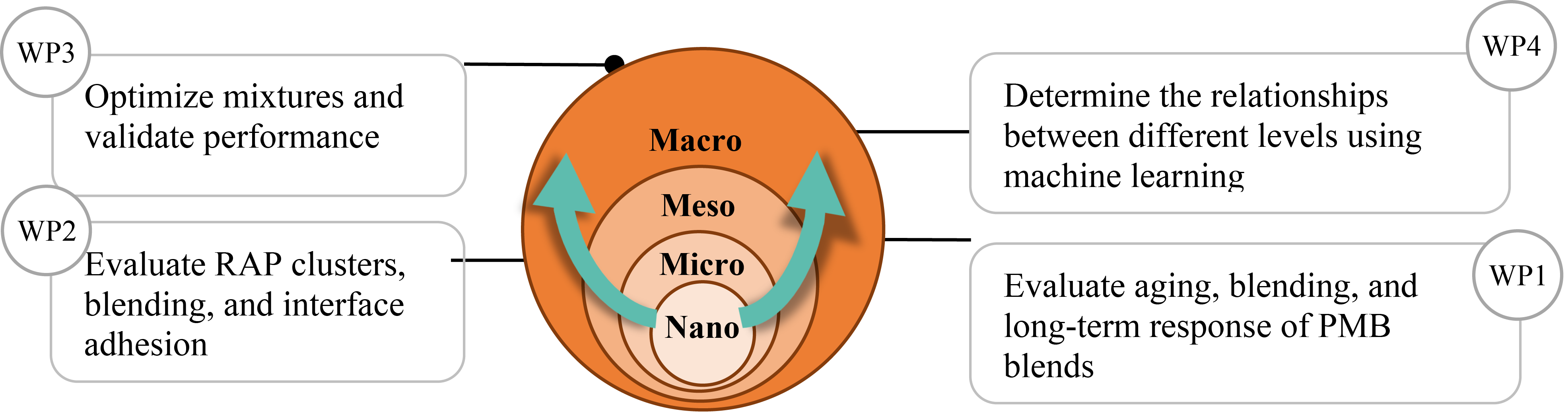
To develop a fundamental chemical, morphological, and rheological understanding of the effect of aging and blending of the polymer-bitumen system and the long-termresponse of blends of aged and virgin PMB (nano- and micro-scale).
To investigate the impact of RAP clusters on bitumen distribution, blending, and interfacial adhesion within recycled surface mixtures with PMB (meso- and macro-scale).
To determine the relationship between material properties at different scales using machinelearning (nano- to macro-scale).
Budget and timing
The total budget is € 1.365.180,00 for a project duration of 4 years [October 2023 - September 2027].